
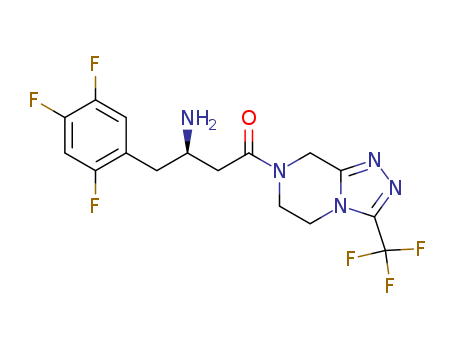
(3R)-3-Amino-1-[3-(trifluoromethyl)-5,6,7,8-tetrahydro-1,2,4-triazolo[4,3-a]pyrazin-7-yl]-4-(2,4,5- trifluorophenyl)butan-1-one
- CasNo:486460-32-6
Product Description
Offer Chemical Raw Material (3R)-3-Amino-1-[3-(trifluoromethyl)-5,6,7,8-tetrahydro-1,2,4-triazolo[4,3-a]pyrazin-7-yl]-4-(2,4,5- trifluorophenyl)butan-1-one 486460-32-6 In Stock
- Molecular Formula:C16H15F6N5O
- Molecular Weight:407.318
- Appearance/Colour:yellow grease
- Vapor Pressure:0mmHg at 25°C
- Melting Point:114.1-115.7 °C
- Refractive Index:1.59
- Boiling Point:529.9 °C at 760 mmHg
- PKA:7.20±0.10(Predicted)
- Flash Point:274.3 °C
- PSA:77.04000
- Density:1.61 g/cm3
- LogP:2.65470
Sitagliptin(Cas 486460-32-6) Usage
|
Mechanism of action |
Sitagliptin prolongs the activity of proteins that increase the release of insulin after blood sugar rises, such as after a meal. Sitagliptin is a selective inhibitor of the enzyme dipeptidyl peptidase-4 (DPP-4), which metabolizes the naturally occurring incretin hormones glucagon-like peptide-1(GLP-1) and glucose-dependent insulinotropic polypeptide (GIP) resulting in enhanced glucose-dependent insulin secretion from the pancreas and decreased hepatic glucose production. Since GLP-1 enhances insulin secretion in the presence of raised blood glucose levels, inhibiting DPP-IV activity will increase and prolong the action of GLP-1 by reducing its rate of inactivation in plasma. Sitagliptin reduces hemoglobin A1c (HbA1c), fasting and postprandial glucose by glucose-dependent stimulation of insulin secretion and inhibition of glucagon secretion. GLP-1 has other widespread effects including delaying gastric emptying, significantly reducing glucagons levels and possible central effects on the appetite. |
|
Pharmacokinetics |
Bioavailability of sitagliptin is approximately 87%. Halflife is between 8-14 hours. It is 38% bound to plasma proteins. It undergoes limited metabolism via CYP3A4 and CYP2C8. Elimination is mainly through urine. |
|
Indications |
Sitagliptin is approved by the FDA as an adjunct to diet and exercise to improve glycaemic control in patients with T2DM, either as a monotherapy, or in combination with metformin or a peroxisome proliferatoractivated receptor-γ agonist (for example, thiazolidinediones) when the single agent does not provide adequate glycaemic control. |
|
Side effects |
In clinical trials, sitagliptin demonstrated an overall incidence of side effects comparable to placebo. The most common side effects in studies were upper respiratory tract infection, stuffy or running nose, sore throat, headache and diarrhea. The incidence of hypoglycemia with sitagliptin monotherapy was not significantly different than placebo. Pooled data from 2 monotherapy and 2 combination trials show that the incidence of hypoglycemia was 1.2% and 0.9% for sitagliptin 100mg and placebo respectively. |
|
Drug interactions |
Sitagliptin plasma concentrations may be increased modestly (approximately 68%), with cyclosporine which is not expected to be clinically important. Digoxin plasma levels may be increased slightly (approximately 18%), no dosage adjustment is recommended. Although sitagliptin is not as likely to cause hypoglycemia as some other oral diabetes medications, be careful while prescribing any other drug that can potentially lower blood sugar, such as: probenecid, nonsteroidal anti-inflammatory drugs (NSAIDs), aspirin or other salicylates, sulfa drugs, a monoamine oxidase inhibitor (MAOI) or beta-blockers. |
|
Definition |
ChEBI: Sitagliptin is a triazolopyrazine that exhibits hypoglycemic activity. It has a role as a serine proteinase inhibitor, a hypoglycemic agent, an EC 3.4.14.5 (dipeptidyl-peptidase IV) inhibitor, an environmental contaminant and a xenobiotic. It is a triazolopyrazine and a trifluorobenzene. |
|
Brand name |
Januvia |
|
Metabolism |
Sitagliptin undergoes minimal metabolism, mainly by the cytochrome P450 isoenzyme CYP3A4, and to a lesser extent by CYP2C8. Renal excretion of sitagliptin involves active tubular secretion; it is a substrate for organic anion transporter-3 and P-glycoprotein. |
InChI:InChI=1/C16H15F6N5O/c17-10-6-12(19)11(18)4-8(10)3-9(23)5-14(28)26-1-2-27-13(7-26)24-25-15(27)16(20,21)22/h4,6,9H,1-3,5,7,23H2/t9-/m0/s1
486460-32-6 Relevant articles
Highly efficient asymmetric synthesis of sitagliptin
Hansen, Karl B.,Hsiao, Yi,Xu, Feng,Rivera, Nelo,Clausen, Andrew,Kubryk, Michele,Krska, Shane,Rosner, Thorsten,Simmons, Bryon,Balsells, Jaume,Ikemoto, Nori,Sun, Yongkui,Spindler, Felix,Malan, Christophe,Grabowski, Edward J. J.,Armstrong III, Joseph D.
, p. 8798 - 8804 (2009)
A highly efficient synthesis of sitaglip...
Identification of ammonium chloride as an effective promoter of the asymmetric hydrogenation of a β-enamine amide
Clausen, Andrew M.,Dziadul, Brianne,Cappuccio, Kristine L.,Kaba, Mahmoud,Starbuck, Cindy,Hsiao, Yi,Dowling, Thomas M.
, p. 723 - 726 (2006)
An investigation into the cause of subst...
Sitagliptin inhibit human lymphocytes proliferation and Th1/Th17 differentiation in vitro
Pinheiro, Marcelo Maia,Stoppa, Caroline Lais,Valduga, Claudete Justina,Okuyama, Cristina Eunice,Gorj?o, Renata,Pereira, Regina Mara Silva,Diniz, Susana Nogueira
, p. 17 - 24 (2017)
Dipeptidyl peptidase-4 (DPP-4) inhibitor...
Preparation method of chiral 4 - aryl - β β-amino acid derivative
-
, (2021/11/14)
Provided is a method for preparing a chi...
IMPROVED PROCESS FOR PREPARATION OF SITAGLIPTIN
-
Page/Page column 10-15, (2021/12/31)
Provided herein is a process for the pre...
Synthesis method of sitagliptin free alkali and sitagliptin phosphate monohydrate
-
, (2021/07/24)
The invention relates to a synthesis met...
Synthesis method of sitagliptin free alkali
-
Paragraph 0024; 0054-0061, (2021/07/17)
The invention belongs to the field of or...
486460-32-6 Process route
-
![(R,R)-N-benzyl-N-(α-methylbenzyl)-1-(2',4',5'-trifluorophenyl)-4-oxo-4-{3''-(trifluoromethyl)-5'',6''-dihydro-1'',2'',4''-triazolo[4,3-α]pyrazin-7''(8''H)-yl}butan-2-amine](/upload/2026/4/12f9c9c8971d4b8aa90c7bee04803781_c5f2206a-5248-491c-a261-7393efcbaea5.png)
-
1380521-88-9
(R,R)-N-benzyl-N-(α-methylbenzyl)-1-(2',4',5'-trifluorophenyl)-4-oxo-4-{3''-(trifluoromethyl)-5'',6''-dihydro-1'',2'',4''-triazolo[4,3-α]pyrazin-7''(8''H)-yl}butan-2-amine

-
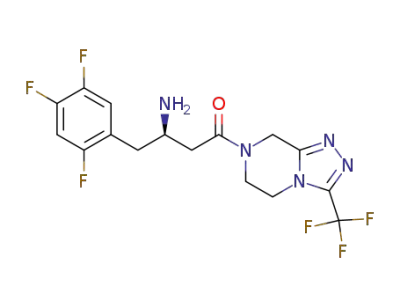
-
486460-32-6,823817-55-6
sitagliptin
| Conditions | Yield |
|---|---|
|
With
30% w/w Pd(OH)2/C; hydrogen;
In
methanol;
for 24h;
under 3800.26 Torr;
|
96% |
|
With
5%-palladium/activated carbon; hydrogen; acetic acid;
In
methanol;
at 50 ℃;
for 48h;
under 19001.3 Torr;
|
95% |
-
![(3R)-3-[[(1S)-1-carboxamidophenylmethyl]amino]-1-[3-(trifluoromethyl)-6,8-dihydro-5H-[1,2,4]triazolo[4,3-a]pyrazin-7-yl]-4-(2,4,5-trifluorophenyl)butan-1-one](/upload/2026/4/7868b4a45d984104850b1db6c7a2a24c_fabb0bfd-8faf-419e-ac61-f1cc115ce8e3.png)
-
769195-20-2
(3R)-3-[[(1S)-1-carboxamidophenylmethyl]amino]-1-[3-(trifluoromethyl)-6,8-dihydro-5H-[1,2,4]triazolo[4,3-a]pyrazin-7-yl]-4-(2,4,5-trifluorophenyl)butan-1-one
-
-
486460-32-6,823817-55-6
sitagliptin
| Conditions | Yield |
|---|---|
|
With
20% palladium hydroxide-activated charcoal; hydrogen; acetic acid;
In
methanol; water;
at 50 ℃;
for 14h;
under 7500.75 Torr;
|
85% |
486460-32-6 Upstream products
-
486460-23-5
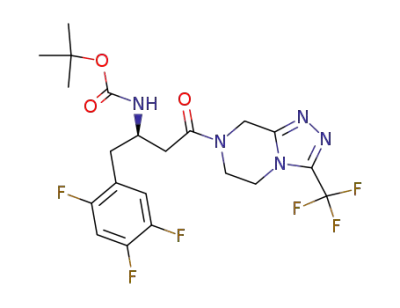
(R)-tert-butyl 4-oxo-4-(3-(trifluoromethyl)-5,6-dihydro-[1,2,4]triazolo[4,3-a]pyrazin-7(8H)-yl)-1-(2,4,5-trifluorophenyl)butan-2-ylcarbamate
-
157911-56-3
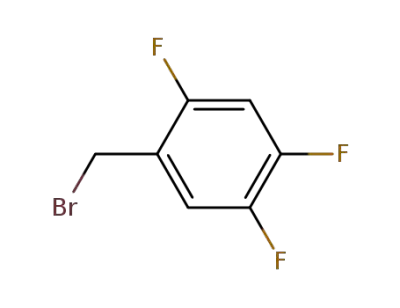
2,4,5-trifluorobenzyl bromide
-
486460-21-3
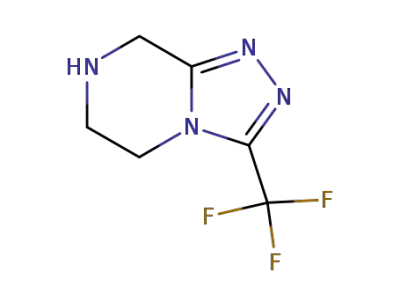
3-trifluoromethyl-5,6,7,8-tetrahydro-[1,2,4]triazolo[4,3-a]pyrazine
-
486460-00-8
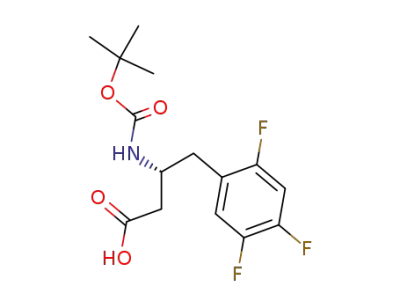
(3R)-3-[(1,1-dimethylethoxycarbonyl)amino]-4-(2,4,5-trifluorophenyl)butanoic acid
486460-32-6 Downstream products
-
654671-78-0
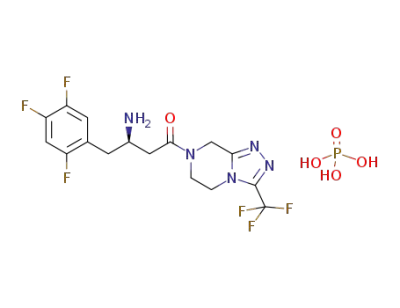
sitagliptin phosphate
-
654671-77-9
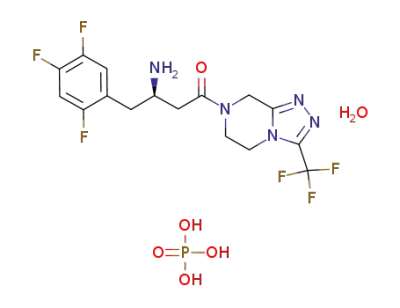
sitagliptin phosphate monohydrate
-
1169707-35-0

sitagliptin benzoate
-
837430-24-7
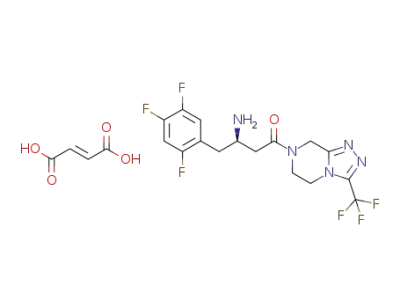
Sitagliptin fumarate